Innovations
Circular economy: giving composite materials a second life
When an aircraft reaches the end of its flying life, Airbus no longer asks how to dispose of it, but how to keep its materials flying. This is the heart of the “Circular Economy", an approach that keeps high-value materials in use to slash waste and energy consumption.
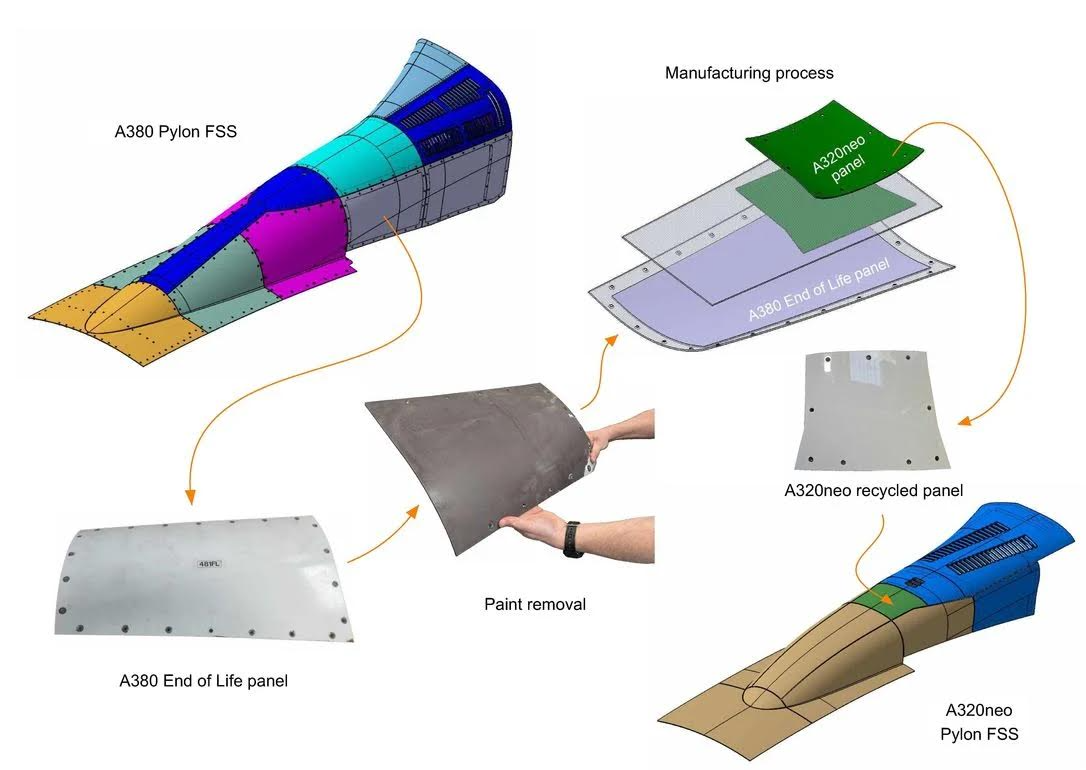
From A380 to A320neo: a practical circular solution
Airbus has just proven what is possible by taking a thermoplastic pylon cowl from a retired A380 and 're-manufacturing' it into a new, smaller part for the A320neo. The results are impressive: the repurposed part is so high-quality that it’s actually indistinguishable from a brand-new panel, both in how it looks and how it performs.
This initiative makes the "Circular Economy" a tangible reality for the aerospace industry. By successfully reprocessing these advanced materials, Airbus is reducing reliance on brand-new materials and the energy-intensive processes required to produce them.
This success achieved thanks to a strong collaboration of aerospace partners across the value chain, effectively "closes the loop" on the material's lifecycle, representing a new achievement for the consortium of industry leaders that recycled and repurposed the thermoplastic composite aircraft part. Each partner played a specialized role in this circular ecosystem:
● Toray Advances Composites: developed and manufactured recyclable thermoplastic composites for the A380; pioneered stamp-forming techniques that enable component reuse and significantly reduce lifecycle waste.
● TARMAC Aerosave: as a specialist in end-of-life (EoL) recycling, it provided the EoL A380 source parts that initiated the project diverting high-value assets.
● DAHER: manufactured and produced the new A320neo components by industrializing the process for repurposing recovered composite materials.
● Airbus: validated the thermoplastic recycling process through flight testing on an A320neo ahead of commercial deployment.
The impact of this project extends far beyond a single part. Because the A380 contains over 10,000 thermoplastic parts, it serves as the ideal platform for validating large-scale recycling practices.
The data gathered from this initiative will contribute to the Airbus' eco-design strategy. This ensures that new components are engineered from the outset to maximize material recovery at the end of their lifecycle. Furthermore, for its role in this collaborative breakthrough, Toray received the 2026 JEC Composites Innovation Award in the Circularity & Recycling category, proving that when the industry works together it unlocks solutions bigger than any single company could achieve alone.
For more information contact:
Name: Elodie Battaglia
Position: Communications Officer VIE
Email: elodie.battaglia@airbus.com